Southgate: Early Photographs taken in 1946
Southgate: Early Photographs
By Norman Lucey
Long before you were born whilst I was in my last two years at school I started to compile an album of places of interest (I thought so) in Southgate. This project sad to say was never completed but I have unearthed what I had achieved and thought you might like to see some photos of that time. The years are 1945-46. The war was just coming to an end and we were once again allowed to take photographs (an otherwise punishable offence during the war years). Commercial films were still not available in the shops but the government surplus shops that were springing up everywhere started to sell RAF surplus panchromatic film which was sensitive to red light and could only be processed in complete darkness. Hence it was a challenge to do everything by feel and guesswork in the cupboard under the stairs with no light at all. These photos were taken with an Ensign box camera passed on to me by my parents from days long before the war. Not a very elegant piece of equipment. As part of this project I photographed all the underground stations within the borough of Southgate which are attached below.
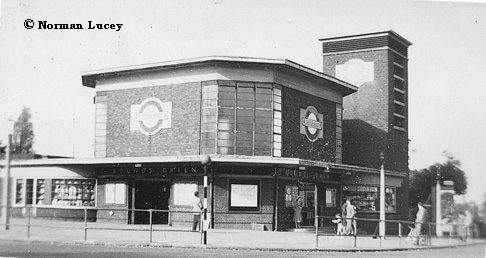
Bounds Green
This was taken before the traffic lights were installed at the junction of Green Lanes and Brownlow Road. The window to the right-hand of the right-hand entrance is a post office. The shop at the extreme left I cannot remember as to what it sold but it may have been an estate agent.
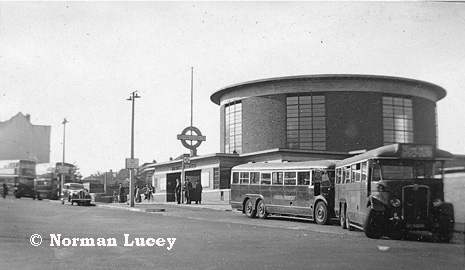
Arnos Grove
The shops here were all inside the station there being Waltons the greengrocer and W.H.Smith, newsagent. Note the six wheeled single decker buses. This was route 251 from Arnos Grove to Burnt Oak underground station. These would stand waiting where you see them for some time before they left for their journey and they were always parked with a heavy wooden scotch against the nearside front wheel because of the hill. I can remember spending many a happy hour when I was very young dragging this enormous weight which had a metal tube handle from the side of the pavement to the bus wheel for the drivers when they arrived. I think I must have been part of the scenery. If you look just behind the second bus you will see a recess in the brick wall this contained a large watering can type vessel which was filled at a tap in the recess for drivers to regularly top up their engines which commonly arrived spurting steam everywhere. The double decker buses on the extreme left are the number 84 which plied between Arnos Grove and St. Albans. The car standing outside the station I recognise as being a pre-war Vauxhall.
Southgate
You see from the clock that this was taken at 7.15 one fine sunny morning. Note the policeman on his beat standing in the shop doorway. This was a confectioners shop. The white angled sign standing on the roundabout is labelled Southgate Circus and the road sign with the black and white post with a black box on the top is an illuminated road sign saying roundabout. Illuminated road signs were unusual in those days. Next to the Belisha beacon is a curbside fire alarm painted red. On smashing the glass and pulling the handle the fire engine would be summoned. These were fairly common when public phone boxes were rare.
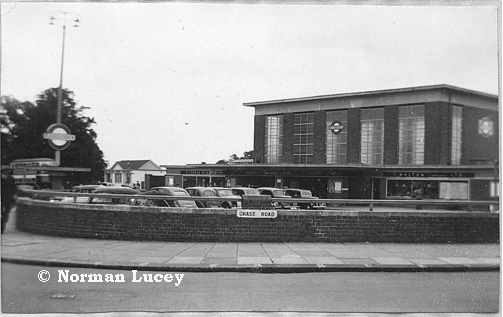
Oakwood
This station bears the name Oakwood although this sign must have been very recent when the photo was taken. It used to be called Enfield West (Oakwood) and by public demand it was changed to reflect the areas association with Southgate rather than Enfield. Note to the left of the entrance is the Victoria Wine Company and on the right T. Walton (London) Ltd. a greengrocers that had a shop in most underground stations. On the extreme left a small hut like building is Barclays Bank. The bus just entering the picture from the left is route 107 Ponders End to Borehamwood. This service was served by austere vehicles introduced during the war painted brown not red. They had wooden seats, single sheet walls and roof, with no heating, were very uncomfortable and noisy. They were manufactured by Guy.
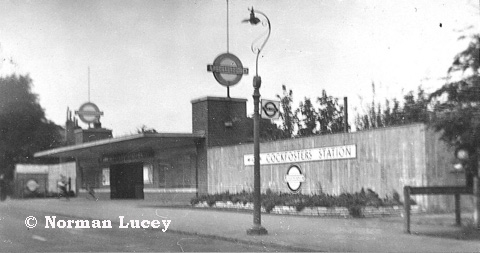
Cockfosters
A very sparse station with no shops other than a newsagent. It had three terminal platforms at road level. Truly the end of the line.
This information and the photographs are strictly copyright and shall not be reproduced without prior permission in writing from Norman Lucey
Published by Norman Lucey
e-mail: norman@lucey.net
© Copyright 2001, Norman Lucey. All rights reserved.